Antevion tracks the follow-up recommendations clinicians write in imaging reports,so each one has an owner and a due date, and shows the hospital how many were never done.
Designed to read each signed report, quote the clinician's own sentence and hand the recommendation to the department the hospital has configured as responsible, with a named person and a due date. Antevion never writes for the clinician and makes no clinical decisions.
Illustrative example
Fig. 1 — One sentence from a report, as Antevion records it
CT pulmonary angiogram · Emergency · 12/03
«Nódulo de 6 mm no lobo superior direito; recomenda-se TC de controlo1em 6 a 12 meses2.»
Translation: “6 mm nodule in the right upper lobe; a control CT is recommended in 6 to 12 months.”
1Action
control CT
Quoted from the report
2Interval
6 to 12 months
Due at the end of the range
3Owner
Pulmonology
By the hospital’s rule
4Due date
12/03 (+12 months)
Exam date + interval
Everything Antevion records comes from the words in the report. It never suggests an interval.
Illustrative example with fictitious data. It does not represent a real patient, clinician or hospital.
01 — The problem
The recommendation is written down. Nobody is holding it.
Hospitals don't lack detection. They lack anyone who holds the state “recommended but not yet done”.
The report goes to the doctor who ordered the scan, often for an unrelated reason. The recommendation is prose in a document, not a task in anyone's queue. Nobody can count what is outstanding.
The loss concentrates between departments: a nodule on an emergency CT pulmonary angiogram, or on an abdominal CT, that belongs to pulmonology.
One report, two pathsIllustrative example of a typical case, not a real patient.
Two paths for the same report. Today: the report with the recommendation goes to the emergency doctor, the patient is discharged and pulmonology never receives the recommendation. With Antevion: the sentence is recorded, it goes to pulmonology with a named person and a due date, a later exam is proposed and a member of staff confirms.
Day 0 · CT pulmonary angiogram ordered by the emergency department
«Nódulo de 6 mm no lobo superior direito; recomenda-se TC de controlo em 6 a 12 meses.»
Translation: “6 mm nodule in the right upper lobe; a control CT is recommended in 6 to 12 months.”
Today
Day 1
The report goes to the emergency doctor. The embolism is ruled out and the patient is discharged.
Week 1
Pulmonology never receives the recommendation.
Month 12
The due date arrives. No reminder, no list it appears on.
After
The scan is never done, and nobody can see that it is outstanding.
No follow-up
With Antevion
Day 1
The recommendation is handed to pulmonology, with a named person.
Week 1
The due date is on pulmonology’s list, taken from the clinician’s interval.
Month 12
A chest CT that was performed is proposed as a possible fulfilment.
After
A member of staff confirms. Nothing closes on its own.
Completed, confirmed by a person
What published studies show
53.8%
Of 1,910 CT pulmonary angiograms at three Toronto teaching hospitals, 35.3% showed lung nodules. Only 25.1% of patients with new nodules needing follow-up got an explicit follow-up recommendation, and 53.8% of those were not re-imaged on time. 1
39%
In a US safety-net cohort of 551 patients with incidental 5–8 mm lung nodules, only 28% completed guideline surveillance; 39% had none documented. 2
29,723
Portugal performs more CT scans per person than any other EU country: 29,723 per 100,000 inhabitants (hospitals only). 3
None of this is anyone's fault. It's structural.
02 — How it works
It carries the clinician's own words to the people who act on them.
Follow one fictitious case from report to confirmation. The clinician’s sentence travels intact; a wrong proposal is rejected; only a person closes it.
Illustrative example with fictitious data. It does not represent a real patient, clinician or hospital. Dates, department and sentence are fictional. Criteria are shown as “met” or “not met”, never as a score.
Illustrative example
One case, from the report to confirmation
0104
Sentence01
Department02
Proposals03
Confirmation04
Illustrative example with fictitious data. It does not represent a real patient, clinician or hospital. Dates, department and sentence are fictional. Criteria are shown as “met” or “not met”, never as a score.
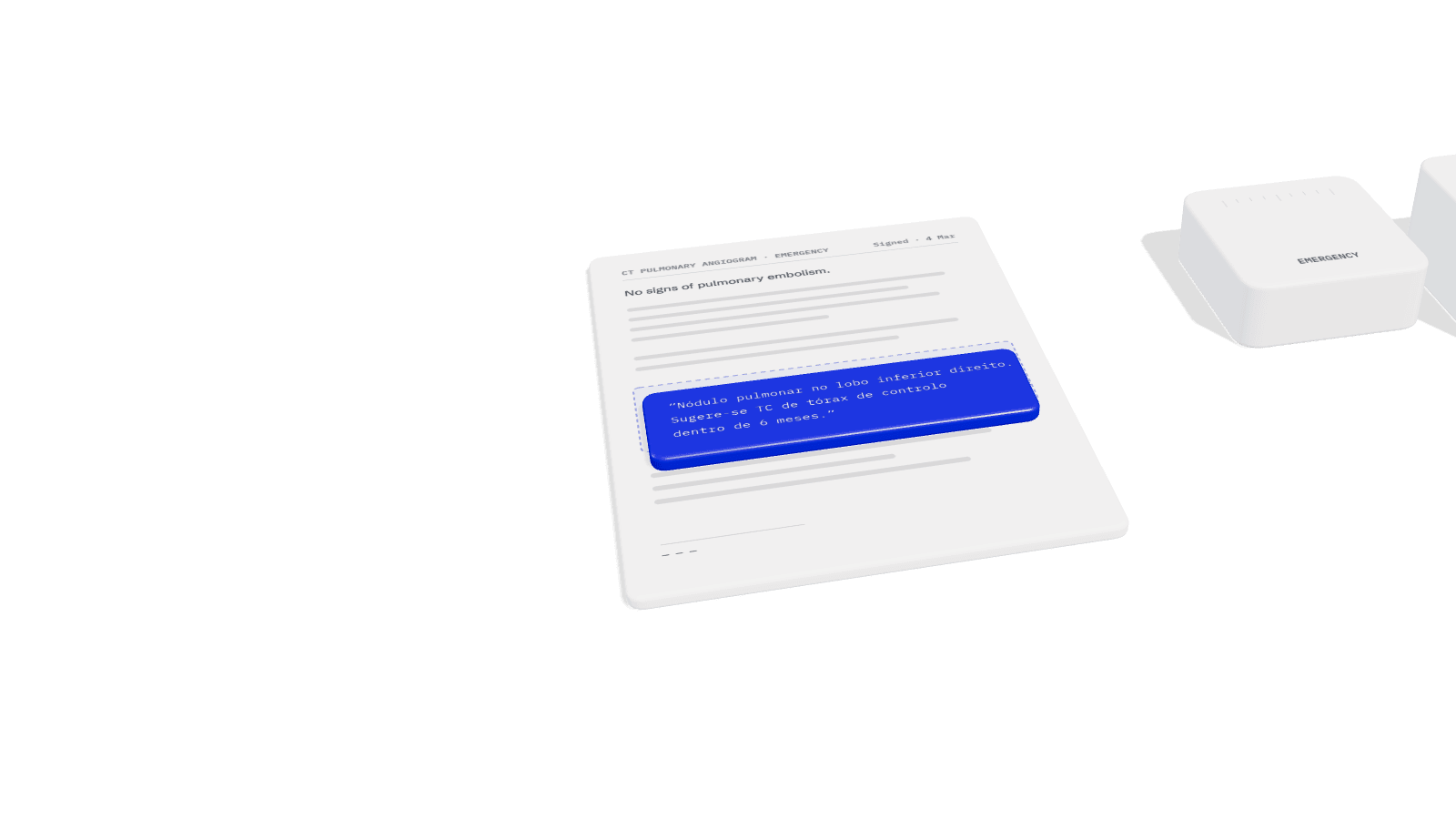
1 · Report sentence
CT pulmonary angiogram · ordered by Emergency · signed 4 Mar
“Nódulo pulmonar no lobo inferior direito. Sugere-se TC de tórax de controlo dentro de 6 meses.”
Translation: “Pulmonary nodule in the right lower lobe. A control chest CT within 6 months is suggested.”
Recorded: action “chest CT” · interval “6 months” — both quoted from the sentence
2 · Owning department
Pulmonology — configured by the hospital for this type of finding
Owner: pulmonology coordinator
Due: 4 Sep — from the interval the clinician stated
3 · Proposed fulfilments
A · Chest radiograph · 12 May
✓Same patient — met
✕Exam type named in the recommendation — not met
✓After the report — met
Rejected by the pulmonology coordinator: a different type of exam from the one recommended. Nothing closes. The reason is recorded.
Does not close
B · Chest CT · 21 Aug
✓Same patient — met
✓Exam type named in the recommendation — met
✓After the report — met
Awaiting confirmation
4 · Confirmed by a person
Confirmed by the pulmonology coordinator · reason: recommended exam performed
State: completed
Illustrative example. A sentence from a CT pulmonary angiogram report is recorded; the recommendation goes to pulmonology, due 4 September. A chest radiograph is proposed and rejected because it is not the recommended type of exam — nothing closes. A chest CT is proposed, confirmed by a person, and the follow-up is completed.
01
Records, quoting
It reads each signed report of the scan types in scope and records the follow-up recommendation the clinician wrote, quoting the clinician's own sentence.
02
Hands it to the owning department
It hands the recommendation to the department the hospital has configured as responsible for that type of finding, with a named person and a due date taken from the interval the clinician stated.
03
Asks the author
When a recommendation lacks an interval or an action, it asks the report's author to complete it. It never fills it in.
04
Proposes; a person confirms
It proposes the later exam or appointment that may fulfil the recommendation, for a member of staff to confirm. Nothing closes automatically. A near-miss is rejected and nothing closes.
05
Accepts follow-up done elsewhere
It lets the patient tell the hospital that the follow-up was done at another provider. Staff verify it before anything changes.
06
Counts, and states its coverage
It reports, by department pair, how many recommendations were completed, completed elsewhere, closed as not indicated, overdue, or never actioned, and always states its coverage.
These steps describe how Antevion is designed to work.
03 — Limits
What Antevion never does
These limits are deliberate.
01It does not analyse images.
02It does not generate or suggest recommendations, intervals, guideline categories or treatments.
03It does not estimate risk, and does not rank or colour patients by clinical priority.
04It does not close a follow-up. A person always does, with a reason.
05It never claims a list is complete. It states what it covers.
06It does not use one hospital's data for anyone else.
04 — The audit
Start with your hospital's own number.
A retrospective audit of 12 months of reports, before any workflow changes.
Matching later exam or appointment found (unverified)·(no data: filled by the audit)
No follow-up found·(no data: filled by the audit)
No follow-up found, by department pair
Emergency → Pulmonology·(no data: filled by the audit)
Internal medicine → Pulmonology·(no data: filled by the audit)
Prepared with the hospital’s named clinical leadLayout of a demonstration report. The numbers come from your hospital’s audit.
Illustrative example with fictitious data. It does not represent a real patient, clinician or hospital.
Illustrative example of an audit report, without numbers: an empty bar with two categories and two rows by department pair.
What we analyse
01A file export of 12 months of signed chest-CT-family reports: CT pulmonary angiography, emergency and abdominal CT with lung bases, chest CT, and cardiac CT.
02Later exams and specialty appointments, where the hospital can export them.
What the hospital receives
01For each recommended follow-up, whether a matching later exam or appointment was found in the hospital's records (unverified) or no follow-up was found, by ordering → owning department. Follow-up done at another provider is usually not observable in an audit, and the report says so.
02How often in-scope findings were reported with no follow-up statement — counted, and never queried.
03Transcription accuracy, measured against a clinician-labelled sample of the hospital's own reports.
04A written statement of coverage and of what could not be observed.
What it requires
01A data-processing agreement and a DPIA, completed with the hospital's DPO.
02A named clinical lead.
03No change to anyone's workflow, and no patient contact.
Duration and terms
01About 6 weeks of analysis once the data is available.
Antevion asks; it never writes for the radiologist. Incomplete recommendations go back to their author. Nothing is pre-filled or suggested.
Illustrative example
Question to the author
Chest CT report · signed 2 Feb
“Nódulo no lobo superior esquerdo; sugere-se controlo imagiológico.”
Translation: “Nodule in the left upper lobe; imaging follow-up suggested.”
Missing: exam type · interval
Exam typeMissing
IntervalMissing
Record follow-upNo follow-up intended
The fields start empty. There is no default.
Illustrative example with fictitious data. It does not represent a real patient, clinician or hospital.
Illustrative example of a question to the author: the report sentence, the missing fields (exam type and interval) left empty, and two options — record follow-up or no follow-up intended.
Pulmonology and cardiology
Follow-ups left undone concentrate between departments. The audit shows, for each department pair — who ordered the scan and who owns the finding — how many recommended follow-ups have a matching later exam or appointment, and how many have no follow-up found.
Illustrative example
By department pair · pulmonology as owning department
By department pair · pulmonology as owning department
Ordering department
Matching later exam or appointment found (unverified)
No follow-up found
Emergency
Matching later exam or appointment found (unverified) — (no data: filled by the audit)
No follow-up found — (no data: filled by the audit)
Internal medicine
Matching later exam or appointment found (unverified) — (no data: filled by the audit)
No follow-up found — (no data: filled by the audit)
Cardiology
Matching later exam or appointment found (unverified) — (no data: filled by the audit)
No follow-up found — (no data: filled by the audit)
General surgery
Matching later exam or appointment found (unverified) — (no data: filled by the audit)
No follow-up found — (no data: filled by the audit)
Coverage: scan types in scope · period · reports processed against expected
Your audit fills this table with your hospital's numbers.
Illustrative example with fictitious data. It does not represent a real patient, clinician or hospital.
Example table with no numbers: ordering departments (Emergency, Internal medicine, Cardiology, General surgery) against two audit categories — matching later exam or appointment found (unverified) and no follow-up found — with pulmonology as owning department. The audit fills the cells.
Quality and risk
Antevion is designed so that every closure records who made it and why, and every report states its coverage — a verifiable record your quality and risk committee can review.
Illustrative example
Closure record
Closed by
Pulmonology coordinator
Reason
Recommended exam performed
Evidence
Chest CT · 21 Aug
Coverage
Scan types in scope · period · reports processed against expected
Illustrative example with fictitious data. It does not represent a real patient, clinician or hospital.
IT and data protection
Designed to be hosted in the EU, single-tenant, with the hospital as data controller under a GDPR Article 28 agreement. No real patient data before a signed data-processing agreement and a DPIA.
Illustrative example
The data path in the audit
Hospital: file export of 12 months of reports
Single-tenant environment, designed for EU hosting
Audit report delivered to the hospital
Hospital — data controllerAntevion — processor (GDPR Art. 28)
Before any real data: a signed data-processing agreement and a DPIA.
Illustrative example with fictitious data. It does not represent a real patient, clinician or hospital.
The data path in the audit: a file export from the hospital, a single-tenant environment designed for EU hosting, and a report delivered to the hospital; the hospital is the controller and Antevion the processor.
Board and procurement
The audit is a fixed fee, sized for a direct award, with about 6 weeks of analysis once the data is available. It requires no change to anyone's workflow.
a data-processing agreement, a DPIA and a named clinical lead
06 — Evidence
What the published evidence shows
78%Tracked
52%Never reported
A community-hospital lung-nodule tracking service saw 78% of tracked patients complete follow-up, versus 52% of patients never reported to it. 4
31
Across 31 studies of interventions to improve lung-nodule follow-up, tracking systems appeared the most effective — though most studies carried a serious risk of bias. 5
The audit measures this in your hospital: how many recommended follow-ups have a matching later exam or appointment in your own records.
07 — Regulation and data
Intended purpose, responsibilities and regulatory status
01
What Antevion does not do
Antevion does not analyse images, estimate risk or propose treatment. Antevion never generates an interval and never suggests a recommendation.
02
Who decides
Clinicians make every clinical decision. A person confirms every closure, with a reason.
03
Regulatory status
We do not yet have a written qualification opinion on Antevion under the EU Medical Device Regulation. Until we do, we make no claim about its status. We will obtain one before any pilot with real patient data.
Data protection
Designed to be hosted in the EU, single-tenant, with the hospital as data controller under a GDPR Article 28 agreement.
No real patient data before a signed data-processing agreement and a DPIA.
One hospital's data is never used for anyone else.
Development and demonstrations use illustrative reports only.
Hospitals entering an audit will receive our data-processing agreement, DPIA support and intended-purpose statement.
This is Antevion's intended-purpose text. Nothing we say in public goes beyond it.
Intended purpose. Antevion is administrative workflow software for hospitals. It records follow-up recommendations that clinicians have written in imaging reports, quoting the report text on which each record is based. It routes each recorded recommendation to the department that the hospital has configured as responsible for that type of finding, and assigns an owner.
It calculates due dates only from intervals stated by a clinician. Antevion never generates an interval. Where a recommendation states no interval, Antevion opens the follow-up recommendation immediately in the owning department as "no interval recorded" and, at the same time, asks the report author to state one. If the author has not answered within the number of days the hospital has configured, a named clinician in the owning department sets the interval. Where a recommendation lacks an action, Antevion asks the author to complete it.
Where the hospital enables it, Antevion also asks the report author to state whether follow-up is intended when a report mentions a finding type for which the hospital's reporting policy requires a follow-up statement and none was found.
Antevion identifies later scheduling events, namely a performed examination or an appointment of the kind the recommendation names, that may fulfil a recommendation, for staff to confirm. It sends messages to responsible staff and family doctors and, through the hospital's own channels and in wording approved by the hospital, to patients. It reports completion rates.
Antevion does not analyse images, assess the clinical significance of findings, generate or suggest clinical recommendations or intervals, estimate risk, prioritise patients on clinical criteria, monitor treatment, or propose treatment. All clinical decisions are made by clinicians.
08 — Platform
One core for clinical intentions written in free text.
Antevion is designed as an accountability layer for what clinicians write: it quotes the clinician's words, gives each intention an owner and proves whether it happened. Imaging follow-up is the product in development: it is where this core starts, not where it ends.
01
Quote
The clinician's exact words, never paraphrased and never generated.
02
Own
A named owner and a due date taken from the interval the clinician stated.
03
Prove
A person confirms that it happened, with a reason. Nothing closes on its own.
04
Measure
What was never done, by department pair, with its coverage.
Further products are planned on the same core, each with its own regulatory review.
09 — Products
One product in development. Five planned on the same core.
Every product is designed on the same principles: it quotes the clinician, never generates an interval or a verdict, and a person decides.
In development ·onboarding its first partner hospitals
Designed to quote each follow-up recommendation in a signed imaging report and give it an owner and a due date. It starts with a leakage audit of the hospital's own reports.
Yes. Hospitals have done it with a dedicated navigator and manual processes, such as Nodule Net. 4 These depend on someone reporting each patient and on staff finding each completion, and a single hospital cannot see follow-up done at another provider. The audit shows where your own process loses follow-ups.
Does tracking lead to more imaging?
At a hospital that combined tracking with other quality interventions, radiologist recommendations for extra imaging fell 44% (10% to 5.6% of reports) while staying flat at a control hospital, and recommendations that specified what to do rose from 5.6% to 42.3%. 6 Antevion never generates or suggests recommendations; it records only the ones clinicians write.
What about the nodule nobody wrote down?
Antevion works from what clinicians write. Finding an unreported nodule would mean analysing images, which is outside Antevion's intended purpose. Antevion is designed as a vendor-neutral ledger for follow-ups a clinician recorded; we plan to take in the output of detection tools the hospital already uses, but this is not built.
Why not an image-detection tool, or our PACS vendor?
Those tools decide or detect. Antevion carries what a clinician already wrote, across departments and providers. Taking in their output as one more input is planned, not built.
Who works the list?
A named coordinator in the owning department, with protected time agreed in the pilot terms. The worklist is designed to be cleared in about 20 minutes a day.
How is each closure confirmed?
By a person, always, with a reason. A near-miss is rejected and nothing closes — the diagram in “How it works” shows one.
Is Antevion a medical device?
We do not yet have a written qualification opinion on Antevion under the EU Medical Device Regulation. Until we do, we make no claim about its status. We will obtain one before any pilot with real patient data. Its intended purpose is set out in “Regulation and data”.
11 — Contact
Start with a leakage audit
Write to us with your role, your institution and the departments involved. We reply by email and propose a conversation about the audit. Please never include patient data.
Every number on this page comes from a published source. We give each study's setting and year.
1
Kwan JL, Yermak D, Markell L, Paul NS, Shojania KG, Cram P. Follow Up of Incidental High-Risk Pulmonary Nodules on Computed Tomography Pulmonary Angiography at Care Transitions. J Hosp Med. 2019;14(6):349–352.
Three Toronto teaching hospitals (Canada), scans from 2014–2015; a single study. The need for follow-up was judged by the authors.
Lee JS, Lisker S, Vittinghoff E, et al. Follow-up of incidental pulmonary nodules and association with mortality in a safety-net cohort. Diagnosis (Berl). 2019;6(4):351–359.
San Francisco safety-net network (US), 2008–2016. In this study, gaps in surveillance were not significantly associated with mortality.
Aunger J, Yip KP, Dosanjh K, et al. Interventions to Improve Adherence to Clinical Guidelines for the Management and Follow-Up of Pulmonary Nodules: A Systematic Review. Chest. 2025;168(1):248–268.
Systematic review; pulmonary nodules only. The authors state their conclusion with caution.
Abbasi N, Kapoor N, Lacson R, et al. Cumulative Effect of Targeted Interventions on Radiologist Recommendations for Additional Imaging. Radiology. 2025;315(3):e243750.
Two Boston tertiary hospitals (US), non-randomised, over 8 years. The intervention combined education, tracking tools, added staff and performance reports.